Wednesday, April 17, 2013

Spotlight: Odette's Secrets


Wednesday is the middle of the week, which means it's time for a...

 Mid-Week Middle-Grade Spotlight!
featuring:

Odette's Secrets
image from barnesandnoble.com

Odette's Secrets
by Maryann Macdonald
published by Bloomsbury USA
B&N       amazon


Odette's Secrets by Maryann Macdonald is a World War II Holocaust story set in France.  Odette Meyers was a real person and her life was the inspiration for this novel told in free-verse.

Odette, the only child of foreign-born Jews living in Paris, learns to keep secrets - secrets that will save her life.  After her father becomes a prisoner-of-war, her mother joins the Resistance.  Gradually, living in Paris becomes more and more dangerous.  After soldier raid the city in an effort to "remove Jews," she is sent to hide in plain sight in the country.

While living in the country, she keeps her religion a secret, and pretends to be Christian.  At times, the lie seems real and the lines between who she really is and who she pretends to be become unclear.

This book is a quick, but profound and heart-wrenching read.  Its free-verse format and child-like train of thought makes it very accessible for young, but mature readers.  I gave to my nine-year-old as a good introduction to the horrors of WWII.  There are other stories that cover the same time period, but this one does not show the worst of the Holocaust - it has an excellent focus on the healing and recovery of Jewish families in Paris.

Overall, I highly recommend this book to anyone interested in the time period.  I'd like to say ENJOY, but I'm not sure it's the right word for this particular title.  Perhaps, APPRECIATE is the better choice.

Tuesday, April 16, 2013

Nine Pizzas into Nachos?

My Very Elegant Mother Just Served Us......

Nachos?

We all know the order of the planets, but back in second grade when we were learning them, your teacher might have given you a fun saying to help with memorization.  I learned it as My (Mercury) Very (Venus) Elegant (Earth) Mother (Mars) Just (Jupiter) Served (Saturn) Us (Uranus) Nine (Neptune) Pizzas (Pluto).  In 2004, 2005, and 2006, I gave me second grade classes the same saying to help them remember.  (Complete with a pizza worksheet.)  But, my team and I had to do some thinking when we were readying ourselves for The Space Unit in the Spring of 2007.

Pluto's status as a planet had been changed during the International Astronomical Union Meeting in August of 2006.  It was no longer a planet, but had been put into an entirely new group of celestial objects all together - dwarf planets. So, we dropped 'Pizzas' and changed 'Nine' to 'Nachos'.  

Then, we muddled our way through explaining what exactly a dwarf planet is and why Pluto fit the bill.  (Note the verb muddled.)

Well, muddle no longer, teachers and parents. Here's a book that can help.


Plutos Secret
image from abramsbooks.com 
                                                           

Pluto's Secret
An Icy World's Tale of Discovery
by Margaret A. Weitekamp with David DeVorkin
ill. by Diane Kidd
Published by Abrams Books for Young Readers in association with
the Smithsonian National Air and Space Museum
abramsbooks      B&N     amazon

Pluto was discovered by Clyde Tombaugh in 1930, but it has always held a bit of mystery for astronomers.  Its orbit differs from that of the other planets, it changes places with Neptune at times, and it has other icy worlds near it.

Astronomers took into account these "oddities," which were slowly revealed to them through advances in technology, when they created the Dwarf Planet category.  Many people responded to the change by being upset and offended.

The creators of Pluto's Secret present the change in such a way that the reader feels it was the right thing to do.  The illustrations are whimsy and fun, and Pluto is personified in such a way that his charisma is captivating.

The idea that Pluto is not a traditional planet is Pluto's secret. He knows it all along, he's just patiently waiting for us silly humans to figure it out.  And, to Pluto's delight, we did - he even shouts "BINGO!"

So, what makes this book a great one to have in classrooms and libraries?  Goodness, where to begin?

Pluto's Secret is 35 pages of accessible history, science, and emotion.  This one book has the potential to reach a vast audience and make an impression on each reader in a variety of ways. 

First, it gives us, in simple terms, Pluto's story: how it was discovered, named, and later reclassified.

Second, it helps our very youngest readers, who happen to be tomorrow's question askers and answer seekers, that science is always changing - it's the nature of the field.

Third, it promotes patience and acceptance.  Pluto waits for the scientists on Earth to determine what (or who) he really is, all the while he stays happy even as he looks down on the people picketing his reclassification.  He's proud of what he is and is confidant that he will be accepted.

Weitekamp, DeVorkin, and Kidd's work is complete with historical photographs,  a selective glossary, a suggested reading list, and a note from the museum which states "Scientists will continue to uncover the secrets of Pluto...for years to come."  Isn't that something our children can look forward to? 

It is my hope that this book will find itself in classroom, school, public, and personal libraries everywhere.  It has so much to offer in so many ways.  I can't thank the creators enough for bringing this book to publication.

So, give Pluto's Secret a read, I think it is something you will ENJOY!

**Disclaimer: My reviews are my own.  I have not been asked to review the above title by any person, organization, or company.  This review reflects my own opinion(s) of the above mentioned book.  Thank you, Morgan

Friday, April 12, 2013

Valuable Resources

We all want what is best for our children.  We want them to healthy, happy, intelligent, and successful.  Sometimes, it can be overwhelming trying to do all of these things, and we need help.

When it comes to literacy and reading, what are some of the best things we can do?  
Luckily, there are many things we can do to help our kids get off to a great start in reading.  

First, read to them.  

Can reading time be enhanced?  

Absolutely!

Here is a great internet resource filled with basic tips for reading with you child:  Sharing Books

I stumbled on this site, which happens to be The Louisiana State Library's site.  It is full of great tips, ideas, and links for early literacy with a special emphasis on Nursery Rhymes.  (You know how I feel about Mother Goose!)  I particularly like the printable mini-books they provide.

I hope you visit the site and discover a new way to interact with your child during reading time.  Enjoy!

Saturday, April 6, 2013

Busy, Busy, Busy!

It's been more than a week since I've actually posted an entry to The Nursery Librarian.  I'm sorry if you've been hoping to find another good book or tips to help your favorite little one become a true reader - I've just been busy!

We celebrated Easter with family and lots of simple activities in our household.  Our favorite activity was dying eggs, a tradition for our family.  I have to express my excitement over the memory game that PAAS included in the dye box.  We cut it apart and played.  The pieces are in a sandwich baggie in the kitchen drawer to be used on a whim.  Did anyone else discover that great little game too?  Remember, playing memory has lots of advantages.

During the last week, I started two drafts for future posts here on the site.  One is a book review for a book called Pluto's Secret.  An excellent book that helps explain how Pluto became a dwarf planet.  Look for that post sometime in the next few days.

If you need book suggestions for your third through eighth grade child, you'll be pleased to know that I'll be featuring a different book for this age range on Wednesdays.  Books written for this audience, usually called middle grade books, are some of my absolute favorites.  I enjoy reading them and suggesting them to kids in the library.  Look for the first "Middle Grade Marvel" review this upcoming Wednesday.

I've also been reviewing some webinars in order to renew my librarian certificate.  Two of the webinars have brought some great books to my attention, and needless to say, there are 99 items checked out on my library card right now!  I can't wait to go through the piles and find some real gems to use in story times or with my own kids.  Don't worry...I'll tell you all about them too!

Well, it feels good to get another post done for The Nursery Librarian!  Stop back soon for more BOOK FUN!  In the meantime, keep reading to your little one, and ENJOY!

Thursday, March 28, 2013

Load up the SCHEMATA!

Think about the last book you read.

No, not the one you just read with your child.

That one - the one you wouldn't read aloud to your child because it had stuff for grown-ups in it.

What was it?

Me - I just finished a new work of fiction by Andrew Pyper called The Demonologist.

Was your book good?  Mine was excellent.

Did you understand it?  The dialogue, the setting, the themes, the events?

OF COURSE.

How?

Think about it.  How are you able to understand what you read?  Road signs, directions/instructions, blogs and facebook posts, novels and magazines, progress reports, menus ,and the list goes on.....

The odds are good you've been reading for quite some time, and you've had a lot of practice.  You've probably even had the chance to experience many things in the world around you.  You know what it feels like to have sand between your toes, to get ice cream from an ice cream shop, you can remember your first kiss and your first heart break, and surely you've slid your fingers along silk and velvet.  All of these experiences are now a part of you, part of your memory bank, and in turn - part of your schemata.

Reading is a mental act, and while engaged in the act, many things are happening inside your mind.  Mostly, connections are being made between the words you read and the knowledge you already possess, or your schemata (a fancy way of saying background knowledge).

Think of it this way...you are walking around with a giant file cabinet in your head.  It's tall and wide and full of labeled drawers.  Everywhere you go, you pick up a file.  This has been happening to you since birth.

  • The first time you saw a cow...BOOM...filed in the animal drawer.  
  • Your dad said "moo" as he pointed to the cow...BOOM...filed in the sound drawer. 
  • Two weeks later at breakfast, Grandma said "this milk is yummy.  It came from a cow"...POP the animal drawer is opened, a copy of the cow file is made and ...BOOM...copy is filed in the food drawer. 
  •  Later that night, Mom says Hey, Diddle, Diddle, POP...many drawers open and you remember that cows say moo and give milk, they don't jump over the moon.  
  • Now Hey, Diddle, Diddle is very funny!  BOOM...that nursery rhyme is filed in the silly stuff drawer.
This is a simplified way of explaining one part of the reading process, but it's an important part of the process.  Your interactions, intentional or not, are helping to build your child's schemata.  Everything they touch, smell, eat, see, or hear becomes a part of the networked knowledge that will someday make them excellent readers.

So, go out in the world and experience lots of things with and for your little one.  Make bark rubbings with paper and crayons against tree trunks, show them the president's face on a bill from your wallet, take a letter to the post office and walk inside to mail it, put apples in the hanging scale at the grocery store and point to the needle as it moves to show the weight.  Talk about anything and everything, your vocabulary is the foundation for their vocabulary.

Now, go, be brave, say a lot and make lots of connections on behalf of your child's schemata...load it up!  And while you're at it...ENJOY!

Tuesday, March 26, 2013

Preschool Fun Time!

Your preschooler needs to PLAY with YOU!

Recently, I highlighted play as a significant part of a child's learning and literacy.  Consider this a follow up with playtime suggestions for children ages three and four.

Preschoolers, like toddlers, will still enjoy emulating the adults around them.  They'll want to "cook," have a tea party, drive a car, grocery shop, write and draw, and even use a smart phone or computer. Be sure to have pots and pans at the ready along with other objects that will promote dramatic play.

They'll also enjoy constructing hide-outs or forts.  Encourage them to drape blankets over chair backs and coffee tables, then get in the fort with them.  (It might be cramped, so don't feel like you have to stay long.)

At this point in your child's development he/she will enjoy board games.  Candy Land and Chutes and Ladders are some classics.  Memory is another great choice to play with preschoolers for several reasons.

Memory

This is a classic and simple game. The object of the game is to lift cards (or objects) in hopes that a pair is found.  The trick to the game is remembering where each item is located after they've been revealed, which happens to be this activity's greatest benefit.

For very young players, you can limit the number of pairs you are playing with.  Start with only 10 cards (5 pairs) in order to have some success early on, and to let your child comprehend the concept of the game.  As he/she becomes more confidant, add more cards.  You'll find you might be stumped too!

Memory games can be purchased.  Hasbro makes a classic one with bright colors and fun objects on each card.  Not only do they carry the "classic" version, they also sell versions with character favorites like My Little Pony or Lightning McQueen.  At some point, my mother purchased a version, not produced by Hasbro, that is tied to the Pigeon book series by Mo Willems.  A great literary tie-in!

You can also make your own memory games with a variety of supplies: index cards, magazine clippings, and other objects.  Making your own sets allows you to tailor the game to your child's needs.  Here are just a few examples:

  1. Sight Word Memory  - As your child learns new sight words add them to your game.
  2. Letter Matching -  Make matching capital and lower case letters your goal.
  3. Number Recognition - A "matching set" of cards does not have to be identical.  One card in a set could have a numeral while the other card shows a representation of that numeral. For example:
                                                  

Get creative with the game of Memory.  It's a game that requires only a few basic skills, a small amount of time, and meager materials, but has tremendous benefits.  Few games are as adaptable as this one.

Just in case you need some ideas for creating your own versions I've pulled together some internet resources.

and
Here is a neat tactile version using recycled bottle caps.  The blog is in French, but I think the pictures explain the process.  Bottle Caps 

Remember, the game of Memory holds many benefits for young players and their care givers. It's enjoyable, thought provoking, and helps introduce or reinforce different skills.  Whether you make a game or purchase one, the advantages to playing it are endless.  Enjoy!  

Wednesday, March 20, 2013

Book Review - Easy Reader

Finding books for children who are just learning to read can be a challenge.  You want a book with the sight words they've already mastered, words they can easily sound out independently, and some depth when it comes to the actually story.  To be honest, this is a tall order!  Luckily, I've found a title that may be of help.

In January, my daughter and I discovered an Early Reader book, and we both fell in love with it.  To be honest, it was the very first book she read on her very own from cover to cover.

You Can Do It!
by Betsy Lewin
  Holiday House, 2013


An alligator wants to participate in a big race.  He thinks he can win, but a bigger alligator tells him he can't.  His friend, a sweet girl with a pink bow dangling down her scales, encourages him to try.  

The entire tale is told through the use of speech bubbles, and more importantly, with very few words.  Most of the words are basic sight words: can, you, I, do, so, one, two.  Those that are not sight words can be easily sounded out: win, puff.

Betsy Lewin matched simple illustrations with simple text to create a masterpiece for new readers.  It can be read from cover to cover without assistance by a child with limited sight word knowledge.  Plus, it helps young readers understand that the pictures can serve as clues to what the story is telling, developing an important reading skill.  Illustrations are not just enhancements - they do serve a purpose, but that is another blog post. 

The greatest benefit this book has to offer is the message.  You Can Do It!  Of Course - You Can Read! This is an empowering book for our youngest readers, need I say more?

This book is part of series for early readers called I LIKE TO READ, published by Holiday House.  Find a complete list of titles and descriptions here.

Here are some other titles from the series I want to highlight:

Boy, Bird, and Dog by David McPhail - a cute story
Look! by Ted Lewin - simple text, lovely illustrations
See Me Dig by Paul Meisel - a fun story
Pig Has a Plan by Ethan Long - a funny story
I Will Try by Marilyn Janovitz - a positive message


Visit your local library and give some of these titles a try.  
Or, find them at a bookseller: amazon and Barnes & Noble.  

I hope you and you child enjoy them as much as we have in my household. 

Tuesday, March 19, 2013

Visit on Twitter

The Nursery Librarian has discovered Twitter!

If you have already discovered this little piece of the techno world, come follow me @inkandfeathers.

I've had a blast re-tweeting children's book reviews and highlighting resources for early literacy.  

Who knew something so simple could have so many benefits?

Remember...the Nursery Librarian is @inkandfeathers.  

Friday, March 15, 2013

Play Time!

Children need to PLAY!  And they need to play with YOU!

It seems too simple to be true, but the fact is, simple play promotes learning.  This was not new to me when my son began speech services almost three years ago, but I was astounded when I saw how intentional play with simple toys and objects got him to start talking.

Over a span of 18 months, he had four different speech teachers, and from each of them I learned numerous tricks to help his speech develop.  So did his sister!  My daughter may not have needed the speech therapy, but her vocabulary was enriched, and so was her way of thinking about the world around her.  Two of my children gained so much from those 30 minute, bi-weekly visits, and what did they do....PLAY!

Children of all backgrounds need to play, and they need to play with their caregivers and relatives.  When they play with the people they love, the experience is positive - they are comfortable and willing to absorb the world around them.

So, what do you play?

It depends.  Your child's age, interests, needs, and abilities will be a guide when choosing the right game or activity.  For example, you're not going to put a 65-piece puzzle in front of a child who has never seen a puzzle, or ask a 7 year old to play Pat-A-Cake.

For infants:

This is when you play Peek-A-Boo.  Put baby in the high chair, duck yourself down below the tray and spring up shouting "Peek-A-Boo!"  (Be sure to give yourself distance from the tray...your head colliding with it will not make the experience fun for anyone.)

Use "scarves."  Find colorful fabrics and cut them into squares slightly larger than your hands.  While sitting on the floor with baby wave the squares around both of you.  Use words like "high" and "low" to describe the position of the fabric.  Toss several of the squares in the air at the same time and watch them fall around baby.  You can even hold the squares up and say what color it is.  Is the goal to teach our child prepositions and colors?  No.  This is exposure to movement and sounds, and the effects are long lasting.  (If your "scarves" are not hemmed be sure to check them frequently for loose threads which can be a choking hazard.)

For Toddlers:

Try cooking.  You don't need to bake real food to have kitchen fun with a toddler.  You can use the pots, pans, and spoons from your kitchen, or pieces from the kitchen set if you have one.  Toddlers love to emulate the adults around them, and if they see you preparing food, the odds are good, they'll want to do the same.  You can sit on the floor or at a table and mix, flip, and pour the foods your making.  Start developing his/her imagination!  Don't be afraid to say "Please pass me the milk," or "Could I have a bite of that pancake"?  Let them drive the adventure, ask "What will we make today?"  In twenty minutes of pretend cooking, you've modeled good manners, helped develop conversation skills, built vocabulary, and impacted their motor skills in a positive way.


Playing with a child is the greatest, and simplest way to foster learning in a child.  I'm sure you're already doing just that, so give yourself a pat on the back, then go play something new.

I think I've said enough in this entry, but if you've got a preschooler, stop in again at The Nursery Librarian for some playtime suggestions soon.

Until then...Happy Play Time!

Tuesday, March 12, 2013

Another Quality Collection

In my last post, I highlighted Scott Gustafsson's Favorite Nursery Rhymes fom Mother Goose.  Today, I want to bring another delightful collection of rhymes to your attention.

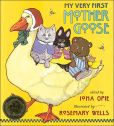
My Very First Mother Goose
image from barnesandnoble.com

My Very First Mother Goose
edited by Iona Opie
illustrated by Rosemary Wells
Published by Candlewick Press in 1996
Rhymes: 68
Purchasing Info: amazon or barnes & noble


1. The Dynamic Duo
 Two very knowledgeable and talented people collaborated to create this work of art.

Iona Opie and her husband Peter are the leading scholars when it comes to Nursery Rhymes.  Through all of my research, I have seen their names repeatedly.  They published The Oxford Dictionary of Nursery Rhymes in 1951, which still stands to be a significant contribution in our understanding of the nursery rhyme tradition. 

Rosemary Wells is an exceptional illustrator and has brought to life many characters in this particular book.  Even Iona Opie speaks of her talent in the forward.

2. The Set-Up
For the most part, there is one rhyme per page, or spread.  At no point do you need to turn the page mid-rhyme.  This is important because it keeps the attention locked in one place for small children, and each page turn is a cue that something new is coming up.

3. The Illustrations
Rosemary Wells has provided simple, color drawings with pleasant animals on every page.  They are big enough and colorful enough to share with babies, but hold enough content to keep a toddler or preschooler interested.  They will also be familiar to fans of her other books, or even the television show "Max and Ruby."  By using this book early, you allow your child to connect not only to words and rhythms, but to an author/illustrator who has an entire cast of characters to grow with and love.  How's that for a life-long reading investment?

4. Familiarity
This book is filled with good ones:  To Market, To MarketHumpty Dumpty; Hey Diddle, Diddle; Jack & Jill; and many more.  (Though I do lament the fact that Miss Muffet is missing.)

Overall, My Very First Mother Goose is another excellent example of a Nursery Rhyme Collection worth sharing with your child.  I hope you enjoy as much as my household does.

Friday, March 8, 2013

A Stellar Mother Goose Collection


Sharing Nursery Rhymes with children every day is an important part of literacy, but choosing the rhymes can be overwhelming.  For many of us, we can simply recall those that were told to us as children.  My favorites were Jack & Jill, Little Miss Muffet, and Hey, Diddle, Diddle.

But what if you are stuck in a rut and want to move past Twinkle, Twinkle Little Star?  Well, you're in luck.  Libraries and bookstores are well stocked with collections of Mother Goose Nursery Rhymes.  But which ones are the best?

I've spent days pouring over some of these collections in hopes to bring the best ones to your attention.  Here is one high quality example.

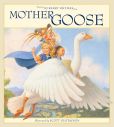
Favorite Nursery Rhymes from Mother Goose
image from barnesandnoble.com

Favorite Nursery Rhymes from Mother Goose
illustrated by Scott Gustafson
Published by Greenwich Workshop Press in 2007
Purchasing Info: amazon  or Barnes & Noble


1. Presentation
Each classic nursery rhymes is laid out on a full two page spread.  In the case of Humpty Dumpty, the words are displayed in large font on the left hand page, while the accompanying picture fills the right hand page.  Some illustrations, such as Jack and Jill, fill both pages  from margin to margin.  This is great because each page turn reveals a new nursery rhyme, and with only one illustration to focus on, predicting the rhyme becomes part of the fun.

2. Quantity
There are 45 rhymes in this collection, a good number when trying to learn the rhymes, or for reading the book cover to cover.

3. Selection
Mr. Gustafson has included the most familiar, including Hey, Diddle, Diddle; Wee Willie Winkie; Bo Peep; Yankee Doodle; and  Mary had a Little Lamb. Yet, they aren't all familiar.  You'll find The Lion and the Unicorn, For Want of a Nail, and Under a Hill.

4. The Illustrations
Overall, this collection is the perfect addition to a personal library for children.  The beautiful illustrations, filled with bright colors and details that span all ages, make this a timeless masterpiece. Every depiction is fanciful (Polly, in Polly Put the Kettle On is a parrot) and worthy of conversation - the questions you could ask a toddler or preschooler are endless.  Try:

  • Goosey, Goosey, Gander - Do you think the goose likes his job?  What is his job? (3-6 yr. olds)
  • Jack Sprat - What is Jack eating?  What is his wife eating? (2-3 yr. olds)
  • Pat-a-Cake - Where is the tea kettle?  Where is the oven? (2-3 yr. olds)
  • Under a Hill - Would you want to visit the lady?  Is she nice?  (4 yrs. and up)
Another advantage to the illustrations in this book is the use of fantasy creatures and humans.  Animals dresses in clothes and doing human tasks is amusing for all children, but the opportunity to see human faces, like their own, is not missed.


Overall, this collection is the perfect addition to a personal library for children if your looking to purchase such a book, or give one as a gift.  It's also worthy of multiple check-outs from your local library if buying isn't on your agenda.

Take a look at Favorite Nursery Rhymes from Mother Goose and be sure to stop back with comments.  Check back again for more reviews of Mother Goose collections.


Saturday, March 2, 2013

3 Reasons to Love Mother Goose

Reciting Nursery Rhymes to children is an age-old tradition and the first step in making your child a life-long reader.

About a year ago, I learned that most modern caregivers do not recite classic rhymes to their children. My heart was broken.  Nursery Rhymes are wonderful for many, many reasons.  Here are three of them:

1. Children Love Them!
The rhythms are fun and soothing.

2. It introduces language.
And enhances vocabulary for older children.

3. They're Music!
We all know music is an essential part of our world.

Keep in mind, there are thousands of Nursery Rhymes - and they come in many varieties.  See if one of these examples sparks a memory in you.

Some are just gibberish:

Hey, diddle, diddle!
The cat and the fiddle,
The cow jumped over the moon;
The little dog laughed
To see such sport,
And the dish ran away with the spoon.

Some are meant to be a game:

Pat-a-cake, 
Pat-a-cake,
Baker's man.
Bake me a cake
As fast as you can.
Roll it, and prick it,
And mark it with a "B."
Put it in the oven
For baby and me.

Some tell a story:

Jack and Jill went up the hill
To fetch a pail of water;
Jack fell down and broke his crown,
And Jill came tumbling after.

And some are all about comfort and closeness:

Rock-a-bye, baby, on the tree top;
When the wind blows, the cradle will rock;
When the bough breaks, the cradle will fall;
Down will come baby, cradle and all.

Sharing language with your child is an important part of literacy.  Singing, or saying, Nursery Rhymes is an easy way to work early learning into your day.  It's simple...
Waiting for a table in a restaurant?  Do the Ipsy Wipsy Spider.

Buckling up the straps of the car seat?  Count: One, Two; Buckle My Shoe.

Mixing eggs for breakfast?  Talk about Humpty Dumpty.

Think about your favorite Nursery Rhyme from your childhood.  Post it in the comment section, then go share it with your child! 

Feel like you need to build up your mental stock of classic rhymes?  Stop back to get reviews on Mother Goose books later this week.

Thursday, February 21, 2013

Welcome!

Welcome to The Nursery Librarian!


This is my place to promote a love of reading, and a love of learning for children.  I hope to reach parents, teachers, and other librarians through this blog in order to share literacy activities for children, children's book reviews, and to highlight some interesting places and events in the history of books for children.

As a former teacher, a public  librarian, and especially as a mother of three, I've learned that reading can not come into a person's life too soon.  And learning does not suddenly start in preschool.  Through simple activities and read-alouds an enjoyment of books, language, and learning is sparked and fostered, giving each and every child an opportunity for success in this world.

Please visit The Nursery Librarian often if there is a child in your life to whom you want to give a life long gift.